
One Day in Zermatt
A realistic single-day plan for Zermatt — one decisive big-view lift (Gornergrat or Glacier Paradise), time in the car-free village, the best photo stops, and the car-free logistics that make a day-trip work.

Photo: Mario Häfliger / Unsplash
- ✓One day means one big mountain choice — pick either Gornergrat or Glacier Paradise, not both.
- ✓Go up early on the clearest part of the day; queues are shortest and the light is best in the morning.
- ✓Leave the afternoon for the village — the Bahnhofstrasse, the church bridge, the old Hinterdorf and a long lunch.
- ✓If you're day-tripping, plan the car-free arrival via Täsch first and check the last train back.
What one day in Zermatt can realistically be
One day in Zermatt is a single, decisive choice rather than a checklist. The valley is read by altitude, and the headline experience is riding one of the great lifts to the high country — but the two flagships, the Gornergrat cog and the Matterhorn Glacier Paradise cable car, sit on opposite flanks of the valley and each eats most of a morning. Trying to do both in a day means rushing both and enjoying neither. So the plan below commits to one big mountain trip in the morning, when the light and the queues are kindest, and gives the afternoon to the car-free village, which is a pleasure in its own right.
It is an honest amount to attempt. You arrive (or wake), ride one headline lift, take the photographs, walk a short high trail or simply stand on the terrace, come down for a long lunch, and spend the afternoon on foot among the larch-and-stone streets before the last train or your dinner. That is a full, satisfying day. The single biggest mistake day-visitors make is over-programming; the second is going up on a cloudy morning when the peak is hidden. This plan guards against both — commit to one lift, and ride it on the clearest window of the day.
- Choose ONE headline lift: Gornergrat (cog) or Glacier Paradise (cable car).
- Morning = the mountain; afternoon = the village.
- Ride up early for the best light and the shortest queues.
- Don't try to fit both big lifts into a single day.
Step 1 — Sort the car-free arrival
If Zermatt is a day-trip, the logistics come first, because the village has been car-free since 1961 and the public road ends at Täsch. Driving, you park at the Matterhorn Terminal in Täsch — a large covered car park — and take the shuttle train into Zermatt, a ride of roughly twelve minutes that runs frequently through the day. Coming by public transport, you can reach Zermatt entirely by rail via Visp and Brig, which is the most relaxed arrival of all and lands you a few steps from the lift stations. Either way, the last leg is a ticket and a climb, not a drive.
The practical points for a day-tripper: check the first reasonable train up and, crucially, the last train back before you commit, so the day doesn't end in a scramble; and don't expect to drive into the village at all. In Zermatt itself it is silent electric taxis, e-buses and your own feet — the main lift stations are close enough to the centre to walk between. Confirm all shuttle and rail times on the official site, as schedules shift by season.

Step 2 — Choose your one big lift
The morning's whole plan turns on a single decision: Gornergrat or Glacier Paradise. Gornergrat is the cog railway — Switzerland's first fully-electric rack railway, running since 1898 — that climbs from beside the main station to an open-air terrace at 3,089 m, the highest open-air railway station in Europe, ringed by 29 four-thousanders with the Matterhorn, the Dufourspitze and the Gorner glacier laid out before you. It is the single clearest introduction to the geography of the valley, easy to ride, and forgiving of altitude. For a first visit, it is the classic and the recommendation.
Matterhorn Glacier Paradise is the other flagship: a chain of cable cars climbing the Matterhorn side via Furi and Trockener Steg to the highest cable-car station in Europe at 3,883 m, with the Glacier Palace ice cave hollowed into the glacier beneath it and an extraordinary close-up of the peak's flank. It goes higher and feels more dramatic, but the altitude is real — take it gently — and the ride is longer. If you want the highest point and the ice cave, choose this; if you want the broadest, most legible Matterhorn panorama and the gentler day, choose Gornergrat. There is a full comparison if you're torn.
- Gornergrat (3,089 m): the cog, the broadest panorama, the gentler day — best for a first visit.
- Glacier Paradise (3,883 m): the highest cable-car station in Europe and the ice cave — more dramatic, more altitude.
- Pick one in the morning; ride it on the clearest window.

Step 3 — Ride up early
Whichever lift you choose, go up early. The morning gives you the cleanest light on the peak, the calmest air, and the shortest queues before the day's crowds build — and it leaves a buffer if the first attempt is socked in by cloud. Check the live webcams and the forecast before you ride; there is no sense paying for the top if the summit is hidden, and on a marginal day it is worth waiting an hour for a window to open. On the Gornergrat cog, sit on the right going up for the Matterhorn; the Gorner glacier opens to the left near the top.
Give yourself unhurried time at the top rather than a quick up-and-down. At Gornergrat, walk out along the terrace and, if you have the legs, drop a few minutes to Riffelsee — the reflection lake just below the summit — for the peak doubled in still water. At Glacier Paradise, take the lift to the viewing platform, then visit the Glacier Palace ice cave below the station. Move slowly at altitude, drink water, and keep a warm layer in your bag even in summer; the high stations are cold and the weather can turn while you are up there.


Step 4 — Come down for a long lunch
Time the descent for lunch, and make it a proper one — the long alpine lunch is half the point of a Zermatt day. If you can spare the extra hour, break the journey down for a terrace meal on the mountain: Findeln, the hamlet of old chalets above the village, is the classic, with the Matterhorn on the table; Riffelalp and Furi have their own terraces on the lift lines. If you'd rather get back to the village, the centre is full of options, from the fondue and raclette stuben to the bakeries for a faster bite. Book ahead in high season, when the best terraces fill.
However you do it, don't skip the meal to cram in more sightseeing. A day in Zermatt is meant to slow down once the headline lift is behind you; the lunch is where the village's unhurried rhythm takes over from the morning's logistics. A long lunch with the peak in view, then an afternoon on foot, is a far better day than a second rushed lift ride.


Step 5 — Walk the village in the afternoon
The afternoon belongs to the car-free village on foot, and it is more than a consolation prize. Walk the Bahnhofstrasse, the main street, and stop on the Kirchbrücke — the church bridge over the river Vispa — for the postcard view of the Matterhorn framed down the street past the church. Wander into the Hinterdorf, the old village core, where weathered timber granaries and barns on their stone staddle-stones (the round slabs that kept the rats out) have stood for centuries; it is the oldest, most atmospheric corner of Zermatt and easy to miss. The mountaineers' cemetery beside the church tells the harder side of the Matterhorn's history.
If a grey sky has hidden the peak, this is exactly where the day still works: the Matterhorn Museum (Zermatlantis) tells the story of the 1865 first ascent and its fatal descent, and the shops, bakeries and bars of the Bahnhofstrasse fill an afternoon happily. With clear weather and energy to spare, a short, gentle walk up toward Winkelmatten or along the river adds quiet and a view without committing to a real hike. Keep an eye on the time if you're catching the last train back.
 Zermatt village walkA self-guided loop through the Bahnhofstrasse, the church bridge and the old Hinterdorf.
 The old village (Hinterdorf)The historic timber core of Zermatt — granaries, barns and centuries of mountain life.
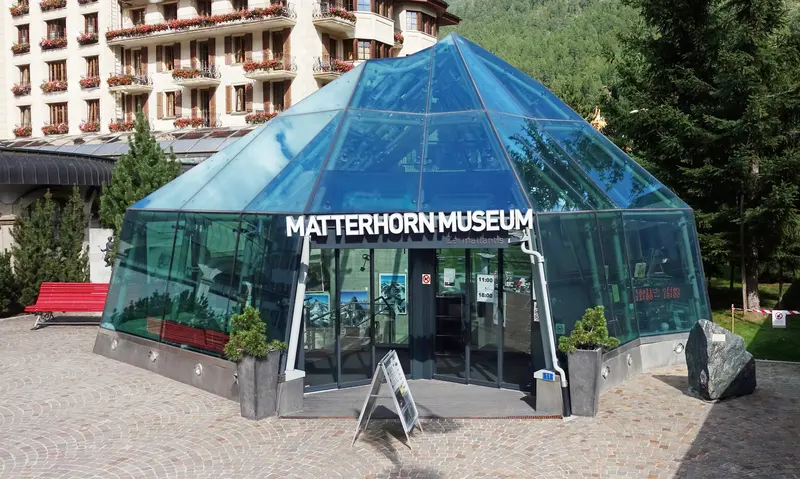 Matterhorn MuseumZermatlantis — the story of the first ascent, ideal for a grey afternoon.
At a glance
A workable shape for one day in Zermatt. The structure and the viewpoints are evergreen; lift hours, the last train back, opening dates and prices change with the season, so confirm them on the official sites before you go.
- Arrive car-free: park at Täsch and shuttle in, or come all the way by train via Visp and Brig.
- Morning: ride ONE headline lift — Gornergrat (gentler, broadest view) or Glacier Paradise (highest, ice cave).
- Go up early for the best light and shortest queues; check webcams first.
- Midday: a long terrace lunch (Findeln) or in the village.
- Afternoon: the Bahnhofstrasse, the church bridge, the Hinterdorf, the museum on a grey day.
- Day-trippers: check the last train back before you commit.
- Carry warm layers even in summer; move gently at altitude.
If you have more time
One day is a taster, and most people who get it leave wanting more. If you can stretch to a second day, the natural next move is the other flank of the valley — the lift you didn't ride, or an easy hike like the Five Lakes loop above Sunnegga — plus a slower morning and a proper dinner. A third day adds real depth: a hike or a ski morning, a spa afternoon, the restaurants you didn't reach. The longer plans build directly on this one, keeping the same flexible-day logic of saving the big views for the clearest mornings.
If a single day is all you have, don't mourn it. A clear morning on Gornergrat or Glacier Paradise, a long lunch, and an afternoon wandering a car-free alpine village beneath the most famous mountain in the Alps is a complete and memorable day — and a very good argument for coming back.
 Two days in ZermattAdd the second flank, an easy hike and a proper dinner to this one-day base.
 Three days in ZermattThe deeper plan — both big lifts, a hike or ski morning, restaurants and spa time.
 All Zermatt itinerariesThe hub of plans by length, season and traveller — ski, summer, couples, family and more.
The day-tripper's version, done right
A large share of one-day visitors are not staying overnight at all but coming in for the day — by train from elsewhere in the Valais or further afield, or on an excursion from a base like Saas-Fee, Visp or the Lake Geneva region. Done well, a day trip can still capture the essence of Zermatt, but it lives or dies on the timetable. The non-negotiable rule is to check the last train out before you do anything else, and to build the whole day backwards from it: a day-tripper who misses the connection down the valley faces an expensive, stressful scramble, whereas one who knows the deadline can relax into the hours they have. Arriving on one of the first trains of the morning, rather than mid-morning, can easily double the useful time on the mountain and put you on the headline lift in the clearest, quietest window of the day.
The single biggest trap for day-trippers is the weather, because they cannot simply wait for a better morning the way an overnight guest can. If the peak is buried in cloud when you arrive, resist throwing money at a viewpoint you will not see; pivot instead to the indoor and lower-altitude pleasures — the Matterhorn Museum, a long lunch, the village on foot, the Gorner Gorge — and treat the high view as a reason to return. Travel light, since there is nowhere to drop bags without planning (the station offers luggage options, but confirm them), keep the plan to one headline experience plus the village rather than a frantic dash at two lifts, and accept that a day trip is a taster by nature. A clear morning on Gornergrat, a terrace lunch and an afternoon in the car-free village is a full, memorable day even without an overnight.
- Check the last train out first and build the whole day backwards from it.
- Arrive on an early train — it can double your useful mountain time and beat the crowds.
- If the peak is clouded, pivot to museum, village and gorge rather than wasting money on a lost view.
- Travel light, plan one headline lift plus the village, and treat the day as a taster.

One day by season
A single day looks quite different depending on when you come, and tuning the plan to the season gets the most from it. In summer the long daylight is a gift to a one-day visitor: you can be on an early lift for a clear-morning view, take a drawn-out terrace lunch, and still have a full afternoon for a short hike or the village before a late, light evening train. The green valley, the lakes and the gentle walks mean even a clouded summit leaves plenty to do at lower altitude, and the warm meadows make the slow afternoon a pleasure rather than a fallback.
In winter, shorter daylight and serious cold compress the day, so front-load the big experience into the bright middle hours and keep the edges cosy. Non-skiers can ride a flagship lift for the view and fill the rest with the museum, a fondue lunch and the lit village; a skier with a single day is better off buying a day pass and simply skiing one or two sectors rather than splitting time with sightseeing, since the lifts and the snow are the point. The shoulder seasons — late spring and autumn — are the quietest and cheapest, with the fewest crowds on the lifts and the easiest restaurant tables, though some lifts and kitchens run reduced hours, so a one-day plan then needs a quick check of what is actually open. Whatever the month, the core discipline never changes: one headline experience on the clearest available window, a good lunch, the village absorbed on foot, and a warm layer in the bag regardless of the date.
- Summer: long daylight lets you fit an early-lift view, a terrace lunch and an afternoon walk.
- Winter: front-load the big experience into the bright hours; skiers should simply ski, not split time.
- Shoulder seasons: quietest and cheapest, but check what's open before you plan.
- Every season: one headline on the clearest window, a good lunch, the village on foot, a warm layer packed.


Gornergrat vs Glacier Paradise
A decision guide to Zermatt's two headline high viewpoints — Gornergrat by cog railway and Matterhorn Glacier Paradise by cable car. How they differ on view, altitude, weather risk, time and who each one suits.
Read guideSelf-Guided Zermatt Village Walk
A gentle, step-by-step loop on the valley floor linking the station, the Bahnhofstrasse, the old timber Hinterdorf, the church and cemetery, the river bridges and the best Matterhorn angles.
Read guide
Best Things to Do in Zermatt
A ranked, first-trip shortlist for a car-free resort under the Matterhorn — the ascents, walks, ski days and long mountain lunches worth building a trip around.
Read guideMore in Itineraries
6
Five days in Zermatt
A fuller, unhurried plan for the car-free village — two headline mountain days, a proper hike or ski day, a rest-and-village day, a day trip by the Glacier Express or over to the lakes and gorges, and the weather flexibility to move any of it to the right morning.
Read guide
Luxury Zermatt Itinerary
A high-end three-to-four-day plan beneath the Horu — a Matterhorn-view suite you wake in at dawn, a hotel spa, a private cog ride to Gornergrat, a guided mountain day, fine dining, and the arrival by Glacier Express — built on the village's quiet, restrained luxury of larch, stone and silence.
Read guideThree Days in Zermatt
A deeper three-day plan — both flagship lifts, Gornergrat and Glacier Paradise, a proper hike or ski morning, the best restaurants, a spa afternoon and the unhurried village time that makes the car-free valley sing.
Read guideTwo Days in Zermatt
A balanced 48 hours beneath the Horu — one headline lift, a contrasting second mountain or an easy hike, the best of the village, two long meals and the room to flex around the weather.
Read guide
Weekend in Zermatt
A Friday-to-Sunday plan for the car-free village — arrival via Täsch or the train, the hotel timing that smooths the first evening, one decisive mountain day flexed to the forecast, and the slow, well-fed Sunday that sends you home unhurried.
Read guide
Zermatt Car-Free Arrival Day
A low-stress first day for a car-free village — parking and the shuttle at Täsch or arriving all the way by train, the luggage and hotel-cart transfer, finding your feet on the Bahnhofstrasse, a gentle village walk past the Hinterdorf and church bridge, and an easy first dinner beneath the Horu.
Read guide