
Churches in Zermatt
The parish church on the Kirchplatz, the little English Church built by Victorian climbers, and the quiet chapels of the valley — the faith woven through Zermatt's farming and mountaineering past.
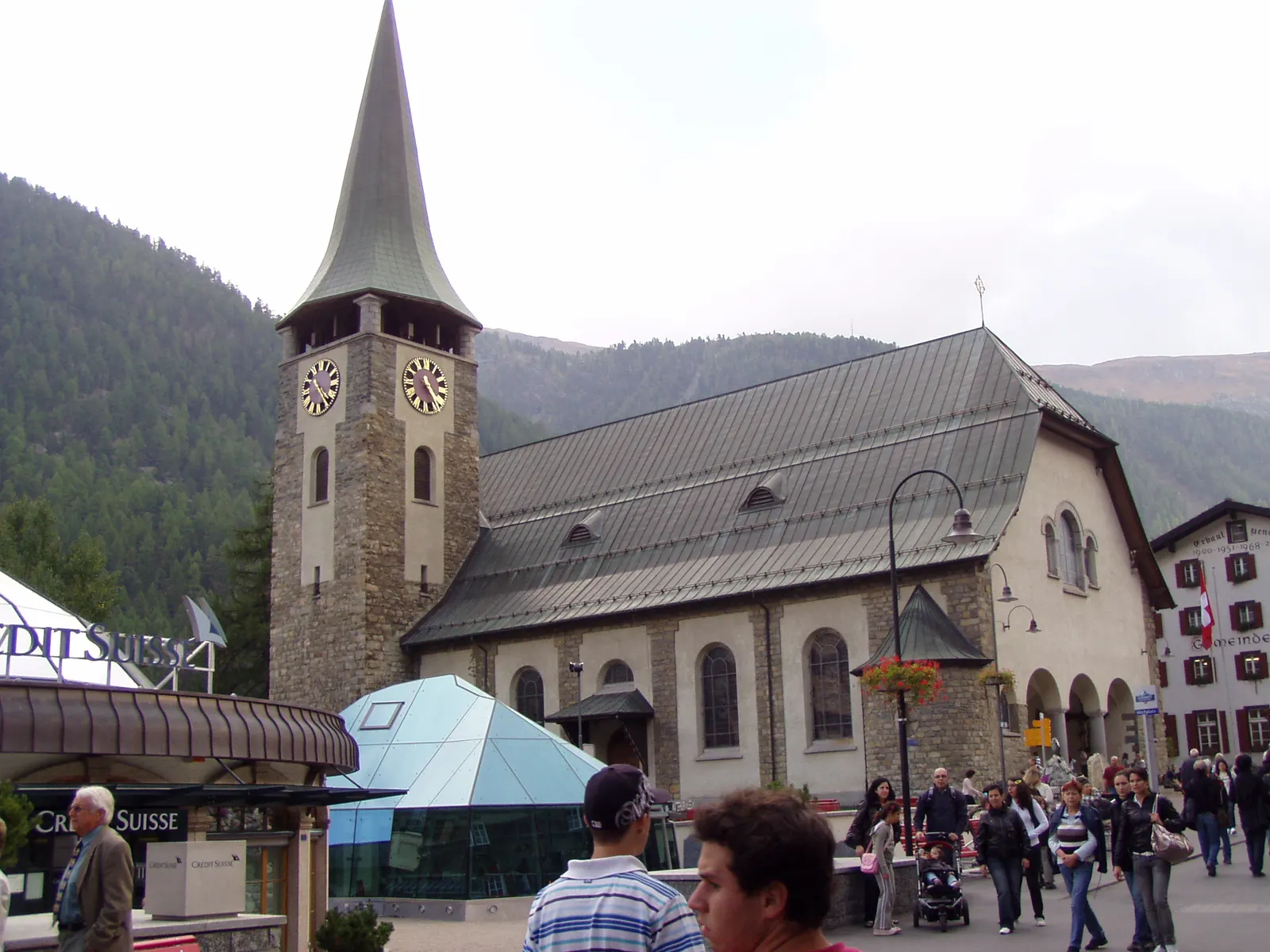
Photo: Addvisor / Wikimedia Commons · CC BY-SA 4.0
- ✓The Catholic parish church of St. Mauritius anchors the Kirchplatz at the centre of the village, beside the museum and the mountaineers' cemetery.
- ✓The small English Church (St. Peter's) was built by and for the British climbers and visitors who flocked to Zermatt in the Victorian era.
- ✓Modest chapels are scattered through the hamlets and high alps above the village, marking the old farming and herding life.
- ✓All are free, central or easily reached, and best entered quietly — they remain places of worship, not exhibits.
St. Mauritius — the heart of the village
Every village in the Catholic Valais grew around its church, and Zermatt is no exception. The parish church of St. Mauritius stands on the Kirchplatz, the open square that is still the true centre of the village — the place the Bahnhofstrasse leads to, and around which the oldest stories cluster. Its white tower is one of the most recognisable silhouettes in Zermatt, and on a clear evening you can frame it against the Matterhorn for a quietly perfect picture of the place.
There has been a church on or near this spot for centuries; the present building reflects later rebuilding, but the role has never changed. Step inside and the noise of the shopping street falls away into cool stone and candlelight. The square outside is where the village's threads converge: the underground Matterhorn Museum lies beneath your feet, and the graves of climbers lie just alongside. To understand Zermatt as a community rather than a resort, start here.
The English Church — a Victorian footnote in stone
Tucked away near the centre is a small, easily missed building that tells one of Zermatt's most important stories: the English Church, dedicated to St. Peter. In the second half of the 19th century, after the first ascent of the Matterhorn made the village famous, Zermatt filled with British mountaineers, alpinists and well-to-do travellers — so many that they wanted a church of their own. St. Peter's was built to serve that Anglican community, and it remains a touching emblem of the era when Britons effectively colonised the Alps each summer.
It is a modest, plain place, very different in spirit from the Catholic parish church a short walk away, and the contrast is part of the point: two faiths, two cultures, sharing one small high valley because of one mountain. For anyone interested in the human history behind Zermatt's rise — the same history told by the broken rope in the museum and the headstones in the cemetery — the English Church is a quiet, eloquent stop.
- St. Mauritius — the Catholic parish church on the Kirchplatz; the village's historic and spiritual centre.
- St. Peter's (the English Church) — Anglican, built for the Victorian British climbing and tourist community.
- Together they trace Zermatt's shift from a farming hamlet to a world mountaineering destination.
Chapels of the hamlets and high alps
Beyond the two village churches, the wider Zermatt valley is dotted with small chapels — in outlying hamlets like Winkelmatten, in the farming clusters, and up on the high alps where herders spent the summer. These tiny buildings, often a single bell and a handful of pews, were the spiritual anchors of a hard, scattered mountain life: somewhere to mark a birth, a death, a safe return from the high pastures.
You will pass several of them on the gentle walks around the village and the lower trails, and they reward a moment's pause. Many are humble to the point of austerity, which is exactly their charm — they belong to the same world as the dark timber barns of the Hinterdorf, the world that existed long before the lifts. Treat any you find open with the same quiet courtesy you would give the churches in the village.
 Self-guided village walkA gentle route linking the station, the Kirchplatz, the old quarter, the church and the river.
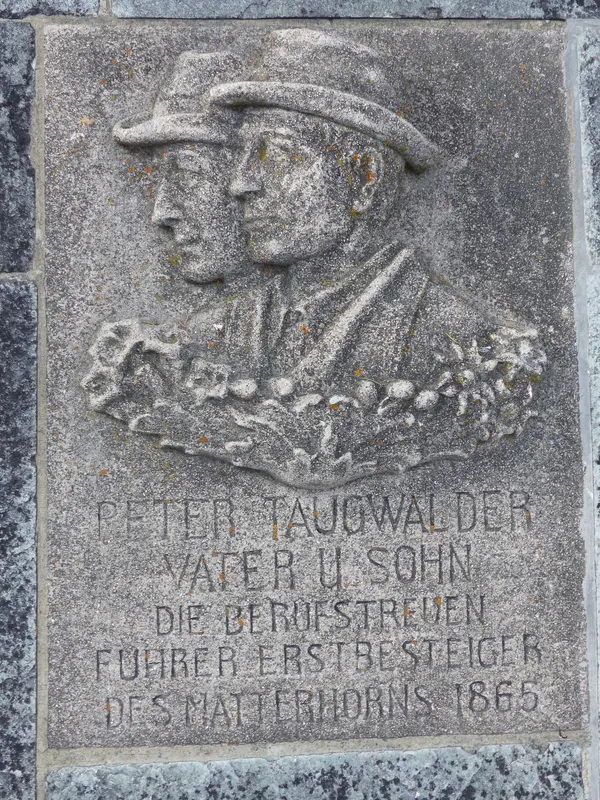 Mountaineers' CemeteryThe graves of climbers beside St. Mauritius — the human story the churches frame.
 Free things to do in ZermattChurches, old houses, riverside paths and Matterhorn photo spots that cost nothing.
Faith and the rhythm of a mountain village
To understand why the churches matter so much in a place now famous for skiing and selfies, it helps to picture the village as it was for most of its history: a small, devout, Catholic farming community living at the edge of what was survivable. The church bell ordered the day and the year. It rang the Angelus, called people down from the fields, marked weddings and funerals, and — crucially in an alpine valley — warned of storms and tolled for the dead carried back from the heights. Religion was not a Sunday matter here; it was woven into the practicalities of staying alive at altitude.
That older rhythm still faintly governs the village. Feast days, processions and the patronal festival of St. Mauritius remain real events in the local calendar, and the parish church is still a working heart rather than a monument. For the visitor, knowing this changes how the buildings read: the white tower on the Kirchplatz is not a photo-prop with a mountain behind it but the centre around which a whole community organised its hopes and fears for centuries. The lifts and hotels are the recent layer; the church is the old one.
Architecture and atmosphere to look for
None of Zermatt's churches is a grand cathedral, and that restraint is exactly their character. The parish church is a solid, white-walled Valais building with a tall, clean tower, its interior cool and ordered, the kind of space that quiets a room of strangers without trying. The English Church is plainer still — a modest Anglican chapel, sober and unadorned, speaking of a transplanted Victorian congregation rather than centuries of local devotion. The high and hamlet chapels are humblest of all: a bell, a small altar, a few benches, often a painted votive image left in thanks for a safe return.
What ties them together is honesty of materials and a sense of proportion to the landscape. These are buildings made by people who lived close to stone, timber and snow, for whom modesty was both a virtue and a necessity. Stand inside any of them with the door open to the cold air and you feel the same thing: a small, human-scaled shelter set against an enormous and indifferent mountain world. It is, in its quiet way, as moving as any view.
- Parish church: white Valais stone, a tall clean tower, a calm ordered interior on the Kirchplatz.
- English Church: plain Anglican chapel, sober and unadorned, a relic of Victorian Zermatt.
- Hamlet and alp chapels: tiny, austere, often with a single bell and votive images of thanks.
- Look for the Matterhorn framed beyond the parish tower — the classic 'village and mountain' shot.
The bells, the calendar and the living parish
One of the easiest ways to feel that Zermatt's churches are alive rather than ornamental is simply to listen. The bells of St. Mauritius still ring through the village, carrying across the rooftops and competing, on a busy day, with the hum of electric carts and the rush of the river. They mark the hours and the services, and on feast days they ring in earnest. To hear them while standing among the dark old houses is to catch, for a moment, the soundtrack of the village as it has been for generations — a sound that predates every cable car by centuries.
The parish keeps a real calendar, too. The patronal feast of Saint Maurice — the Roman soldier-martyr the church is named for — falls in late September and remains a genuine local occasion, as do the major festivals of the Catholic year and the rituals that still cluster around births, marriages and deaths. Visitors are welcome at services, with the usual courtesies, and stumbling into one can be unexpectedly moving: a small, devout congregation in a white stone church, the Matterhorn somewhere outside the door, going about a faith that has outlasted every change the valley has seen. If you would like to attend, ask at the tourist office or parish for current times, which vary through the year.
- The bells of St. Mauritius still mark the hours and services across the village.
- The patronal feast of Saint Maurice falls in late September and remains a real local occasion.
- Births, marriages and deaths still bring the community to the parish church.
- Visitors may attend services with the usual courtesies — verify times locally, as they vary.
Visiting the churches respectfully
All of Zermatt's churches and chapels are first and foremost places of worship, and they are free to enter when open. Go quietly, dress with a little modesty, switch your phone to silent, and avoid wandering in during a service — or, if one is underway, slip in unobtrusively, sit at the back and stay for it or wait outside. Photography is usually tolerated but should never be intrusive; skip flash and skip pictures of anyone at prayer.
Opening times vary, especially for the smaller chapels and the English Church, and there is no fixed schedule you can rely on as a visitor — so treat an open door as a small piece of luck rather than a guarantee. Confirm any service times or special openings with the tourist office or parish if it matters to your plans, and otherwise simply let these stops fall naturally into a slow walk through the village and its surroundings.
- Free to enter when open; go quietly and dress modestly.
- Avoid disturbing services; if one is underway, sit at the back or wait outside.
- Photograph discreetly — no flash, and never people at prayer.
- Opening hours vary, especially for the English Church and outlying chapels — verify locally.
Stitching the churches into a half-day
Because they are free, central and undemanding, Zermatt's churches are best treated not as a checklist but as punctuation in a slow walk. A natural loop starts at the station, drifts up the Bahnhofstrasse, and arrives at the Kirchplatz, where the parish church, the underground Matterhorn Museum and the mountaineers' graves all sit within a few steps of one another. Pause at St. Mauritius, descend into the museum if the weather has closed the heights, pay your respects at the cemetery, then track down the unobtrusive English Church nearby. Drop finally to the Vispa river and follow the rushing water back, and you have threaded the spiritual, historical and natural threads of the village into one unhurried morning.
It is the kind of itinerary that suits a quieter day, a tighter budget, or simply the urge to understand the place rather than just photograph it. Couples find it a gentle, romantic counterpoint to the high-altitude theatrics of the lifts; families find it short enough not to test small patience. And it carries the particular satisfaction of seeing how the resort's glossy surface sits on top of something much older and more human — a faith, a community and a valley that were here long before the first cog train climbed out of the trees.
- A natural loop: station, Bahnhofstrasse, Kirchplatz (church, museum, cemetery), English Church, the river back.
- Free and gentle — ideal for a quiet day, a tight budget or low-altitude rest.
- Pairs the spiritual and historical threads of the village in one unhurried half-day.
Sources
Mountaineers' Cemetery
A respectful guide to the graves of climbers who died on the Matterhorn and the high peaks around Zermatt — the human cost behind the postcard, beside the village church.
Read guideSelf-Guided Zermatt Village Walk
A gentle, step-by-step loop on the valley floor linking the station, the Bahnhofstrasse, the old timber Hinterdorf, the church and cemetery, the river bridges and the best Matterhorn angles.
Read guideFree Things to Do in Zermatt
Village walks, Matterhorn photo spots, churches, old Walliser houses, riverside paths and low-cost ways to enjoy an expensive alpine resort for nothing.
Read guide