
Geissenkehr Goat Parade
Twice a day in summer, Zermatt's black-necked goats are driven down the Bahnhofstrasse to and from their high pasture — a small, free, genuinely local ritual worth catching.

Photo: Mario Häfliger / Unsplash
- ✓The Geissenkehr is the daily summer drive of Zermatt's Valais black-necked goats down the main street to and from pasture — not a staged show but a working tradition.
- ✓It runs through the summer months only, with a morning drive up the valley and an evening return; times shift year to year, so verify locally before you plan around it.
- ✓It is free, lasts only a few minutes, and the best vantage is simply standing back along the Bahnhofstrasse as the herd and its bells come through.
- ✓These are working animals with a goatherd — give them room, keep dogs close, and let the herd set the pace.
A working tradition, not a tourist show
Most of Zermatt's summer happens up on the mountain, but one of its most charming rituals plays out on the village floor. The Geissenkehr — the goat turn, or goat drive — is the twice-daily passage of the village's herd of Valais black-necked goats down the Bahnhofstrasse, the car-free main street, on their way to and from the high grazing. Bells first, then the smell of warm animals and hay, then the herd itself filling the street between the watch shops and the gear stores, with a goatherd keeping the line moving. It lasts only a few minutes and then it is gone, and the street goes back to its usual flow of skiers-turned-hikers and shoppers.
What makes it special is exactly that it is not a performance. The goats are genuinely heading out to pasture in the morning and genuinely coming home in the evening; the Geissenkehr is the village's working life briefly walking through its shopping street. For visitors it is a free, unhurried, very photogenic encounter with the agricultural Zermatt that still runs beneath the resort — and a fine reminder that this was a remote Walliser mountain village long before it was a household name.
When and where to catch it
The Geissenkehr is a summer event: it runs through the warm grazing months when the goats are turned out daily, and it does not happen in winter, when the herd is wintered in barns. There are two passages on each running day — a morning drive out to the pasture and an evening return — and the herd assembles and moves along the Bahnhofstrasse and the streets between the village edge and the slopes above it. Exact start times shift from season to season and can be adjusted at short notice, so the honest advice is to verify the current schedule with Zermatt Tourism or your hotel concierge rather than trust a fixed time online.
To actually see it, you barely need a plan: be on or near the Bahnhofstrasse a little before the listed time, find a spot where you can step back against a shopfront, and wait for the bells. Because the street is car-free, the herd comes straight down the middle and you are often only an arm's length from the animals. The morning drive tends to feel brisker and the evening return more relaxed, with goats that have spent the day grazing ambling home; either way it is brief, so don't wander off to a café and assume you'll catch it later.
- Season: summer only, while the goats graze the high pasture; nothing in winter.
- Two passages on running days — a morning drive out and an evening return.
- Route: along the Bahnhofstrasse and the village streets toward the grazing above town.
- Times change year to year and can shift at short notice — verify locally before relying on them.
- It is free and lasts only a few minutes, so be in place early.

Watching and photographing it well
The goats are tame and used to crowds, but they are still livestock with a job to do, and a good Geissenkehr is one where the herd moves calmly. Give the animals and the goatherd room to pass, don't step into the middle of the line for a photo, and resist crowding a goat against a wall to get a clean shot — a relaxed, flowing herd photographs far better than a startled one. If you have a dog, keep it close and quiet; if you have small children, hold their hands as the herd comes through, both for the children's sake and the goats'. Never feed the animals.
For pictures, the car-free street is a gift: shoot low to catch the goats against the stone-and-larch facades, use the bells and movement for a short video clip, and watch for the moment the herd turns a corner with the rooftops — and on a clear day the Matterhorn — behind. It is one of those small, free, distinctly local moments that ends up being a highlight of a Zermatt summer trip, especially for families. Pair it with a morning on the mountain or an easy walk and you have a day that balances the grand scenery with something altogether more human-scaled.
- Stand back and let the herd and goatherd set the pace — don't block or chase them.
- No feeding; keep dogs close and quiet and hold small children's hands.
- Shoot low against the old facades; a short video captures the bells better than a still.
- Pair it with a mountain morning or an easy valley walk for a relaxed family day.
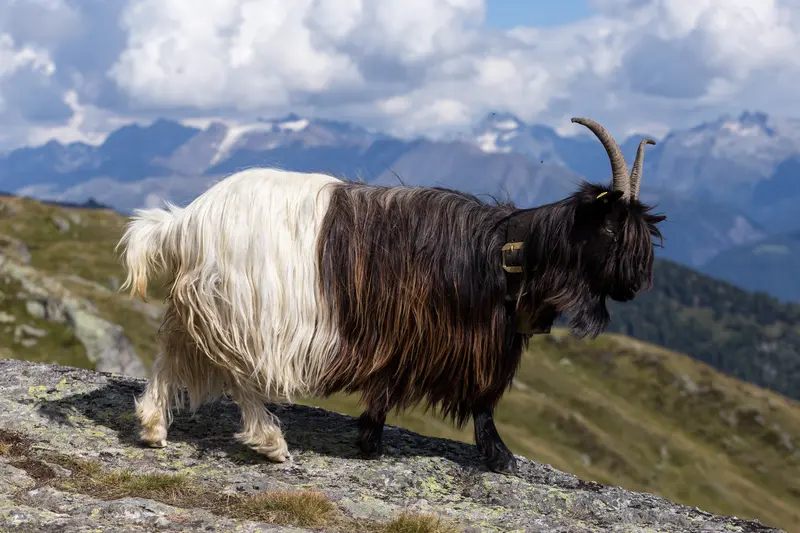
Zermatt's Black-Necked Goats
The black-and-white Valais goats that walk the Bahnhofstrasse on summer mornings — when the parade runs, where to stand, and how to watch it kindly.
Read guide
Bahnhofstrasse Zermatt Guide
The spine of the car-free village — the shops, restaurants, hotels and après-ski energy of Zermatt's main street, with practical orientation from the station to the Matterhorn.
Read guide
Zermatt With Kids
Family-friendly lifts, Wolli Park, Leisee, easy walks, the Matterhorn Museum, sledging and low-stress mountain days in a car-free village built for small legs.
Read guide